


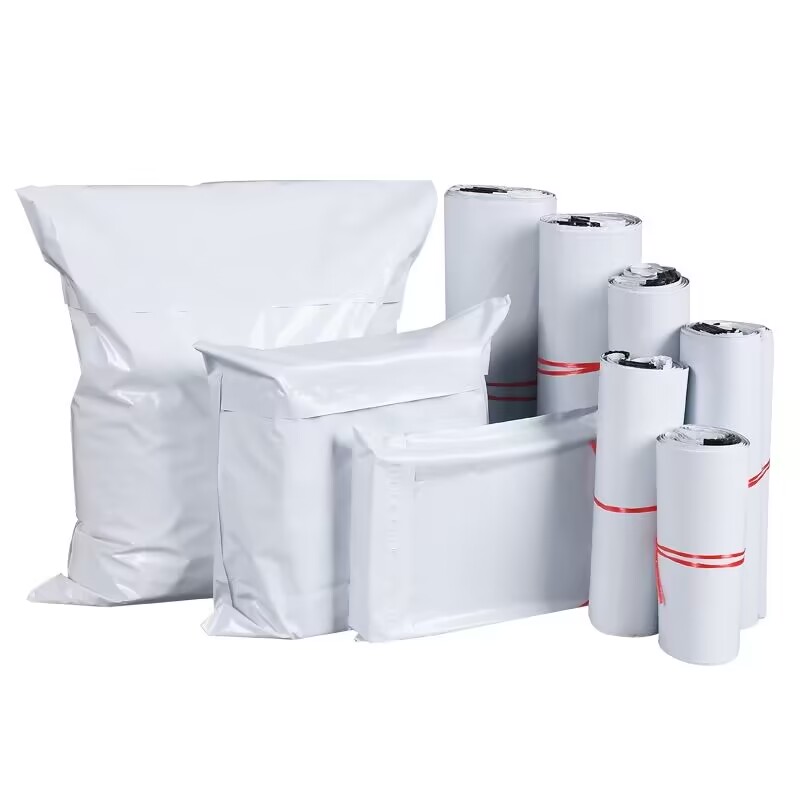
The problem — parcels arrive torn, customers unhappy
Packages rip in transit. Happens often. For e-commerce brands, visible damage kills brand trust. After the 2020 e‑commerce surge — parcels multiplied, handling rougher — carriers pushed more volume, more stress on mailers. The fix is not only thicker film. It is understanding material architecture and print processes. That’s where co-extruded films and factory-direct printed options change the game for clear poly mailers.
Why single-layer mailers fail
One layer. Weakness concentrated. A small puncture becomes a propagating tear. Stress concentrates at the seal or printed area. Many brands add print later — sticker, flexo after extrusion — and that weakens the lamination. Result: lower tear resistance, unexpected failures on conveyor belts and during sorting. Simple reality. Not dramatic, but costly.
Co-extrusion: the science that matters
Co-extrusion builds layers in the melt. Barrier layer. Tough outer skin. Tie layer bonding between them. Layers have roles. The outer skin resists abrasion. The inner provides seal strength. The middle gives puncture resistance. When engineered properly, the film balances tensile strength and elongation — so a shock is absorbed, not split. Industry terms: co-extrusion, barrier layer, tensile strength. These are not jargon. They explain why a mailer tears or holds.
Factory-direct printing — why location of print changes strength
Printing at the factory during film formation avoids secondary treatments that can weaken the polymer matrix. No post-print lamination. No adhesives that create delamination planes. Factory-direct printed poly mailers bond ink at the molecular surface during extrusion or immediately after, which preserves MD/TD orientation and overall film integrity. In short: print done right at the line means fewer failure points. You keep both branding and structural performance.
Design details that stop tears in the wild
Seals matter. Weld design — lap vs. fin — affects tear propagation. Adhesive choice — permanent vs. peelable — changes where stress localizes. Add a reinforced seal or gusset where needed. Use graded thickness: thicker at corners and seals, thinner in body for flexibility. Test on real conveyors. Simulate sorting centers. Small design choices reduce returns. —
Common mistakes brands make
1) Choosing print aesthetics over film engineering. 2) Assuming thicker equals better — sometimes brittleness rises. 3) Ignoring first-article testing with real fill lines. Too many brands skip the line trials and later learn about atomizer catches or sealing failures. Always prototype with exact closure specs. Also consider visible packaging needs — some sellers want product visibility; clear options exist.
Where clear view and clear poly mailers fit
Visibility for returns, branding for luxury unboxings. clear view poly mailers let customers see the product while still benefiting from co-extruded strength. The trick is matching clarity needs with structural requirements: optical quality versus puncture resistance. You can have both — with proper layer engineering and factory-direct printing that doesn’t compromise the film matrix.
Testing and QA — practical measures
Run three tests at minimum: tensile and elongation (benchmarks for MD/TD behavior), puncture resistance (simulate dropped knives and edges), and seal peel strength (real fill-line closures). Measure performance after printing, after simulated freight, and after thermal cycling. Real-world anchor: carriers and sortation centers apply dynamic stresses similar to those observed during the post-2020 parcel boom — test to those conditions.
Alternatives and trade-offs
Paper-based mailers. Biodegradable films. Both greener in perception, but often weaker in puncture resistance or more expensive. Reinforced mailers (woven or laminated) offer extreme durability but change recyclability and cost. Choice depends on distribution channel, product fragility, and return policies. Practical brands weigh total cost of failure, not unit price alone.
Advisory: three golden rules for selecting durable printed poly mailers
1) Evaluate structural metrics, not just GSM: demand tensile strength, puncture resistance, and seal peel values from suppliers. These tell you how the film behaves under real stress. 2) Insist on factory-direct print or validated in-line printing methods: avoid post-print lamination that creates delamination planes and weak points. 3) Validate with end-to-end trials: fill, seal, sort, and deliver using your actual carriers and equipment. Real trials beat lab-only claims.
These rules guide you to lower return rates, fewer customer complaints, and predictable costs. For brands that need both clarity and durability, choosing a partner who builds co-extruded film and prints at source solves many headaches — and that is the value WH Packing brings to the table in practical terms. WH Packing. —
