


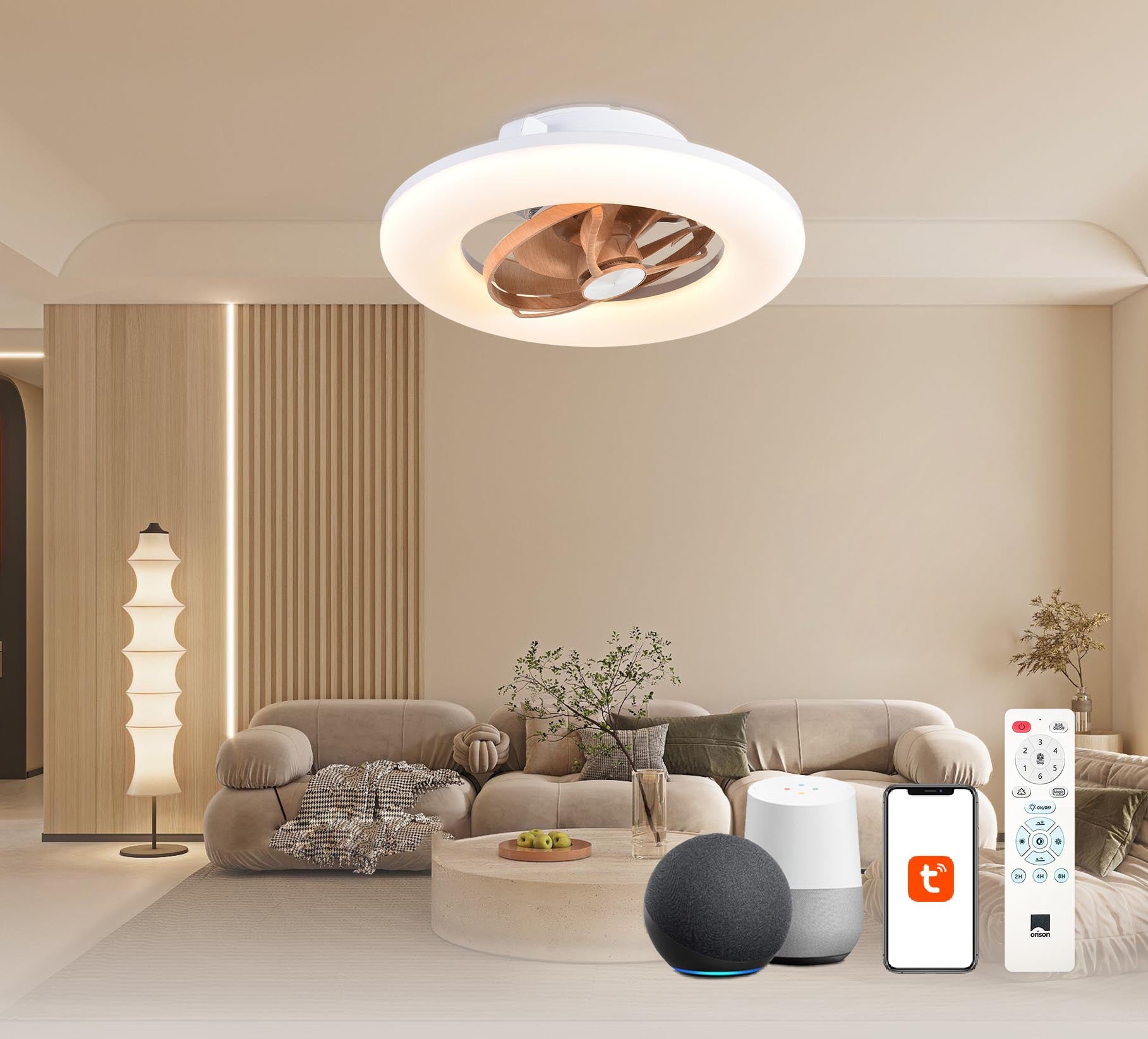
Opening: the problem-driven case for paying attention now
Open-plan living promised flow — but many of us end up with hot corners and chilly aisles, and that’s a real comfort problem. For homeowners who added an alexa ceiling fan or a ceiling fan with alexa, the smart features help, yet they don’t automatically fix uneven air delivery. This piece is problem-driven: we start with why the mismatch happens, then move to diagnostics, fixes, and what to look for when you choose smart hardware and controls.

Why uneven airflow matters in open-plan layouts
Open rooms combine living, dining, and kitchen zones. That’s efficient—until the fan’s airflow pattern favors one area and leaves others stagnant. The result is thermostat fights, uneven perceived temperature, and wasted energy when people crank AC because the sofa corner feels like a sauna. In short: poor airflow undermines the very comfort smart fans promise.
Common causes — simple physics and practical mistakes
Several factors create discrepancies: fan placement too close to walls, wrong blade diameter or pitch for the room size, differing ceiling heights, and obstructions like high-backed sofas. Even motor characteristics matter — a low-RPM motor with small blade sweep produces different CFM distribution than a higher-RPM model. Add mounting height mismatches and you get pockets of slow-moving air. Many installers and DIYers assume a single device will serve the whole open area — but that assumption is often the root cause.
How smart features help — and where they fall short
Smart fans bring voice control, speed profiles, and IoT integration with thermostats and occupancy sensors. Those features let you create schedules or sync fan speed with ambient temperature, which is useful. But software can’t change physics: one fan still has a fixed sweep and centre-biased airflow. Where software excels is in orchestration — coordinating multiple fans or integrating with HVAC setpoints. Use the app or smart hub to reduce conflicts between devices, and you’ll see improvements. —
Practical diagnostics: measure before you guess
Diagnosing uneven airflow doesn’t require pro tools, but some simple measurements help. Use a handheld anemometer for spot-checks, take thermal readings around the perimeter, or use smart sensor logs from an integrated thermostat to spot persistent hot zones. Look at CFM output vs. room volume to see if the fan is undersized. If you have a smart hub, review historical speed profiles to see whether the device actually runs at the speeds you expect.
Design and installation fixes that work
Fixes are often straightforward:
- Reposition fans so sweeps overlap rather than fight walls.
- Add more fans for larger open plans; two medium fans usually beat one oversized unit at distributing air.
- Match blade size and pitch to ceiling height — larger sweep for high ceilings, lower pitch for gentle circulation.
- Use reversible fan direction seasonally to improve mixing and thermally balance the space.
Also consider integrating with your thermostat for thermostat integration — when the fan runs in tandem, you can often raise AC setpoint a few degrees while keeping comfort, saving energy.
Common mistakes to avoid
Brands and installers often slip on three points: undersizing the fan, over-reliance on “smart” presets, and ignoring furniture layout. Don’t trust a default app scene to solve a placement issue. And don’t assume voice control or complex speed profiles alone will fix a shaded corner — those are tools for refinement, not primary solutions.
Choosing hardware: what specs actually matter
When you evaluate a smart fan, focus on a few real metrics: rated CFM (for airflow capacity), motor efficiency (to know how much power it uses for that airflow), and compatibility with voice control and smart hubs. If you plan whole-home orchestration, check for reliable IoT firmware and open integrations with popular platforms. Also ask about real-world noise at different speed profiles — quiet operation matters when you increase run time to balance zones.
Real-world anchor: why this mattered after 2020
The pandemic of 2020 shifted attention to indoor air and comfort — people spent more time at home and noticed airflow issues that went unnoticed before. Building managers and homeowners started prioritizing circulation and ventilation. That shift pushed manufacturers to improve smart integrations and made zoning solutions more mainstream. These changes are practical and lasting.
How Orison fits into the solution
Brands that design with both hardware and cloud control in mind win here. Orison’s products aim to combine sensible airflow (good CFM performance and appropriate blade sweep) with reliable voice control and smart hub compatibility, so you get both the physics and the orchestration right. The brand’s integration focus reduces the friction of coordinating multiple fans and thermostats across an open plan, making the tech a real comfort enabler rather than a gadget — it becomes part of how the space works.
Advisory: three golden rules for selecting strategies and tools
1) Measure first, upgrade second: verify hot/cold spots with simple sensors or logs before buying another device. Proper diagnostics cut wasted spend. 2) Match device to room physics: choose fans by CFM and sweep for the specific ceiling heights and floor plan — not by design alone. 3) Prioritize interoperable smart features: ensure voice control, IoT reliability, and thermostat integration so multiple devices can be orchestrated into a true comfort system.
When you follow these rules you get measurable comfort gains and energy wins — and when the pieces fit, the smart fan stops being a novelty and becomes practical infrastructure, with Orison the kind of partner that helps make the system behave. —
